
Technology
tr-ex.me: The Powerful Context Translation Platform That Changed How People Understand Languages

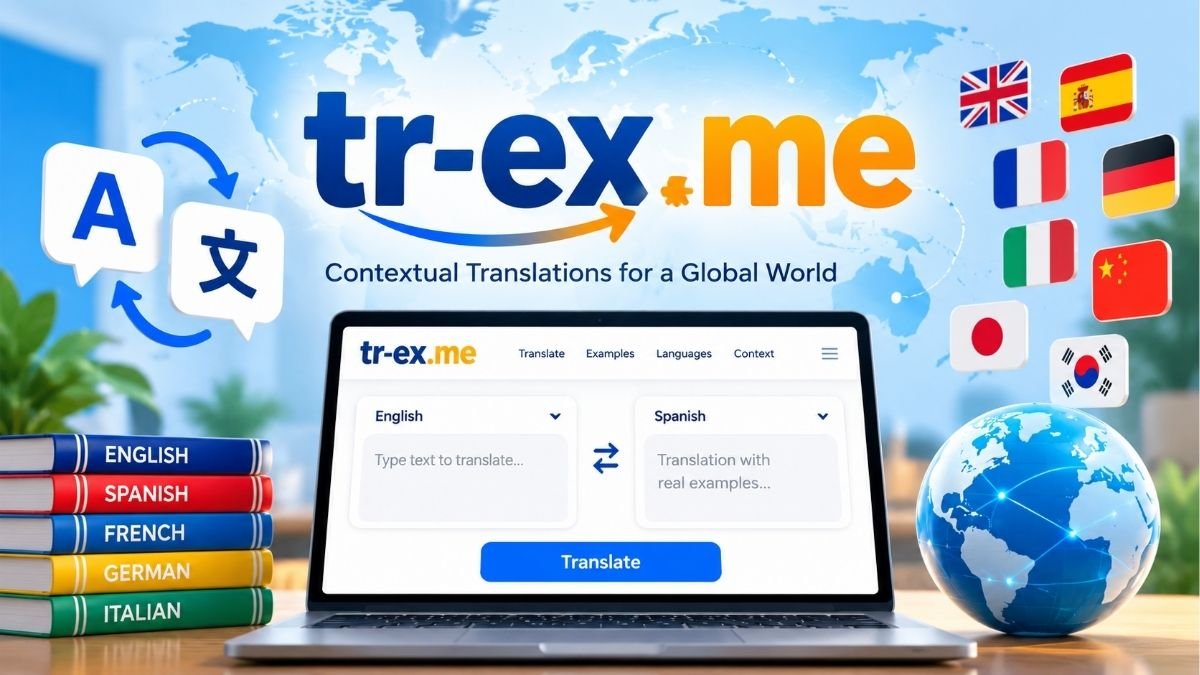
Language translation is no longer limited to finding a single equivalent word in a dictionary. Modern users often want to understand how a word, phrase, expression, or complete sentence actually works in a natural conversation. tr-ex.me became known for addressing this problem through contextual translation. Instead of showing a single translation, the platform presented different meanings alongside examples of how terms could appear in sentences. This approach made it useful for language learners, translators, writers, students, travelers, and people communicating across different languages.
The main attraction of tr-ex.me was context. A word can have several meanings depending on the situation in which it appears, and translating every expression literally can create confusing or unnatural results. By showing translated phrases alongside examples, the service tried to help users choose the interpretation that best fit their intended meaning. Its database covered many language combinations and included everyday expressions as well as vocabulary related to professional or specialized subjects.
This article explores tr-ex.me, its purpose, contextual translation model, key features, benefits, possible limitations, and current accessibility. It also explains why contextual examples can be valuable when learning or translating a language and why users should still apply their own judgment before relying on any automated translation resource.
What Is tr-ex.me?
tr-ex.me is best described as a contextual translation and multilingual dictionary platform. Its pages were designed to provide translations for words and phrases while also showing examples of those terms being used in sentences. That made the experience noticeably different from using a basic dictionary, where a person may receive several definitions but little guidance on which definition fits a particular situation.
For example, a user searching for a word could encounter several possible translations instead of a single answer. Beneath those results, sentence examples could demonstrate how different versions of the term were used. This helped users examine not only vocabulary but also sentence structure, meaning, tone, and context.
The platform covered many language combinations rather than concentrating exclusively on English. Search-indexed pages demonstrate translations involving languages such as Danish and English, while the broader service became known for offering many additional combinations. This multilingual approach helped make the website useful to an international audience.
How tr-ex.me Contextual Translation Worked
The central concept behind tr-ex.me was straightforward: translation becomes more useful when users can see words inside sentences. Languages rarely operate through perfect one-to-one substitutions. One English expression may require a completely different structure in French, Spanish, Czech, Danish, Indonesian, or another language.
A traditional dictionary might tell someone that a particular word has four possible translations. That information is useful, but it does not necessarily reveal which translation sounds natural in a business conversation, informal discussion, academic document, or everyday sentence. Contextual translation reduces that uncertainty by giving users examples to compare.
When searching the platform, users could see suggested translations followed by sentence examples. Some pages also categorize examples by area, such as colloquial, official, medical, financial, computer-related, or political language. Such categorization could help readers recognize that the same term might change meaning depending on the subject.
This does not mean you should automatically copy every example. Instead, examples are most useful as references. Users can compare several examples, identify patterns, and then decide which wording fits their own sentence.
Why Context Matters in Translation
Context is one of the most important parts of accurate communication. Consider an English word such as “run.” A person can run physically, run a company, run software, run out of money, or run a test. Translating the word without looking at the surrounding sentence would make it impossible to choose the correct meaning reliably.
The same challenge appears with idioms. Expressions often cannot be translated literally because the individual words don’t convey the actual meaning. Native speakers understand the expression as a complete unit. Contextual resources such as tr-ex.me try to show users different ways expressions can appear after translation.
Context is particularly important for students and language learners because vocabulary lists alone do not teach natural communication. Seeing a word repeatedly inside different sentences can help learners understand grammar, prepositions, common word combinations, and appropriate phrasing.
Professional translators can also benefit from context examples during research. Even experienced translators occasionally need to confirm how an unusual phrase is commonly expressed. A contextual database can provide additional possibilities that the translator may then evaluate using professional judgment.
Major Features Associated With tr-ex.me
One of tr-ex. me’s strongest features were its combination of translation results and examples. This gave users more information than a simple word-for-word conversion. Search results could present several alternative meanings, helping readers understand that language is flexible.
Another useful element was its support for phrases. People frequently search for complete expressions rather than isolated vocabulary. Translating an entire phrase can reveal grammatical relationships that would disappear if you searched each word separately.
The platform also displayed related terms and alternative translations in many results. These suggestions could be valuable when someone knew roughly what they wanted to say but needed a more natural or specific word.
Its multilingual design was another major characteristic. A user studying a foreign language could potentially move beyond a conventional bilingual dictionary and compare how sentences were constructed in both languages.
tr-ex.me for Language Learners
For language learners, tr-ex.me offered a practical way to explore vocabulary beyond memorization. Learning that a word means something is only the first stage. A student must eventually learn where the word belongs in a sentence, what other words commonly appear around it, and whether it sounds formal, informal, technical, or conversational.
Reading several contextual examples helps build this deeper understanding. A learner might search one expression and discover several sentence structures containing it. Over time, exposure to these patterns can improve reading comprehension and vocabulary awareness.
However, learners should avoid treating every example as a perfect model. Online translation databases can contain awkward, highly specific, outdated, or context-dependent sentences. A better learning method is to compare several examples and check unfamiliar constructions against trusted dictionaries or educational resources.
tr-ex.me for Translators and Writers
Professional translation involves far more than replacing words. Translators must consider tone, audience, subject matter, cultural meaning, and natural phrasing. A resource such as tr-ex.me could serve as an additional research tool when someone wants to explore how a phrase has appeared in different contexts.
Writers working in another language might also find contextual examples helpful. Someone who understands vocabulary reasonably well may still struggle with collocations, which are combinations of words that naturally occur together. An expression can be grammatically correct while still sounding unusual to a native speaker.
Context examples can reveal these patterns. If a particular combination repeatedly appears across relevant sentences, that can give writers clues about natural usage. Nevertheless, always check the final wording carefully, especially for professional publishing, legal material, medical content, or important business communication.
Benefits of Using a Context-Based Translation Tool
The greatest advantage of contextual translation is that it shows language in action. A standard translation result answers the question, “What can this word mean?” Context examples help answer the more practical question, “How can this expression actually be used?”
Such tools can also save research time. Instead of searching dozens of individual websites to locate examples of a phrase, users may find several examples collected in one place. This can make vocabulary exploration faster and more convenient.
Another benefit is exposure to alternatives. People learning a new language sometimes repeat the same basic words because those are the only ones they know. Seeing alternative translations can expand vocabulary and introduce more precise expressions.
The educational value is strongest when users actively compare examples rather than copying them. Looking for differences in grammar, register, and meaning can turn a simple translation search into a small language lesson.
Limitations Users Should Understand
No contextual translation platform should be treated as completely authoritative. Examples may originate from different types of material, and the quality or suitability of individual sentences can vary. A sentence that works in one situation may sound inappropriate in another.
Users should also recognize the difference between translation and interpretation. Translation technology can provide possibilities, but understanding humor, cultural references, sarcasm, emotional tone, and specialized terminology may require human knowledge.
Important documents deserve additional attention. Legal agreements, medical information, academic work, official documents, and commercial contracts should not depend entirely on an automated translation website. Professional verification may be necessary because a small wording change can substantially alter meaning.
Is tr-ex.me Still Available?
The current accessibility of tr-ex.me deserves attention because user reports in 2026 indicated the website became unavailable for some people and returned a 403 Forbidden response. Search engines have continued to contain previously indexed translation pages, which means people may still encounter tr-ex.me results while searching for phrases online.
A domain remaining registered or older pages remaining visible in search results does not necessarily mean that the full translation service is currently functioning. Website availability can change, and users should therefore check the platform directly if they intend to use it.
Former users have also discussed searching for alternatives because they valued the service’s contextual examples. Without an official explanation available for every accessibility issue, it would be inappropriate to assume a specific reason for the disruption.
What Made tr-ex.me Different From a Basic Dictionary?
The main distinction was the emphasis on translation examples. Traditional dictionaries remain extremely valuable because they provide definitions, pronunciation, grammar information, and carefully edited vocabulary entries. Contextual tools serve a different purpose by showing how translations appear in larger pieces of language.
Neither approach necessarily replaces the other. In fact, users can obtain stronger results by combining them. A dictionary can establish the correct definition, while contextual examples can demonstrate practical usage.
This combination is especially valuable for idioms, verbs with multiple meanings, informal expressions, and phrases whose literal translation sounds unnatural.
FAQs
What is tr-ex.me used for?
tr-ex.me was primarily used as a contextual translation platform. It provided translations for words and phrases along with sentence examples intended to demonstrate how those translations could be used.
Is tr-ex.me a dictionary?
It can be described as a multilingual contextual dictionary and translation resource, although it goes beyond standard dictionary definitions by providing translated sentence examples.
Can tr-ex.me help with language learning?
Yes, contextual examples can help learners understand vocabulary, sentence patterns, and different meanings. However, compare examples carefully rather than treating them as perfect language instruction.
Can professional translators use tr-ex.me?
Contextual resources can be useful as supplementary research tools for translators. Professional translators should still verify terminology and consider the subject, audience, and intended meaning before selecting a translation.
Is tr-ex.me currently working?
Users reported accessibility problems with tr-ex.me during 2026, including 403 Forbidden responses. Older translation pages still appear in search indexes, but that does not guarantee the full platform is currently operational.
Conclusion
tr-ex.me became notable because it approached translation through context rather than simple word substitution. By combining possible translations with sentence examples, the platform helped users explore how vocabulary and phrases could function in real language situations. This approach was valuable for students, multilingual writers, translators, travelers, and language enthusiasts who wanted more than a basic dictionary definition.
Its broader lesson remains relevant even as the service’s availability changes: good translation requires context. Words can change meaning according to grammar, subject matter, tone, and cultural usage. Contextual examples provide useful clues, but they work best when combined with reliable dictionaries, language knowledge, and human judgment.
For anyone researching tr-ex, it helps to understand both sides of the platform: its historical usefulness as a context-based translation resource and the accessibility problems users reported in 2026. Whether using tr-ex.me or another translation system, readers should treat translation suggestions as tools for understanding language rather than unquestionable final answers.

Philip Tindall: The Remarkable Life of Mike Tindall’s Father and Former Rugby Captain

Finn Sinclair: Amazing Facts About Olivia Colman’s Son and His Private Life

Maureen E. McPhilmy: The Difficult Divorce from Bill O’Reilly and Her Life Beyond the Headlines

Jessica de Rothschild: The Remarkable Career, Family and Philanthropy of Sacha Gervasi’s Wife

Caroline Friend: The Opera Singer and Audiobook Director Behind Rosamund Pike’s Success

Ted Beckham: The Remarkable Story of David Beckham’s Father

Charlie Comer: Amazing Facts About Jodie Comer’s Brother and His Football Career

Louis Thomas Hardy: Essential Facts About Tom Hardy’s Eldest Son

Elizabeth Anne Hardy: Fascinating Facts About Tom Hardy’s Mother and Her Artistic Life

Cyndy Powell: The Inspiring Story of Glen Powell’s Mother and Her Hollywood Cameos

Mary Joan Hansen: What Is Known About Chris Hansen’s Former Wife

Debbie Paphitis: The Enduring Marriage and Private Life of Theo Paphitis’ Wife

Sam Handel: The Filmmaker, Photographer and Lauren Ambrose’s Husband

Judith Hurst: Who Is Geoff Hurst’s Wife and What Is Known About Their Life Together?

Sophie Redgrave: Who Is Sir Steve Redgrave’s Daughter and What Is Known About Her?

Nerwey Explained: The Truth Behind the Emerging Online Name and Its Digital Identity

Adele Georgiana Gianopoulos: Facts About Molly Ringwald’s Daughter

Eulala Scheel: Marcia Gay Harden’s Child, Acting Credits and Creative Career

Myreadibgmsngs: The Mysterious Search Term Explained, Its Meaning, Origins, and Online Safety

Londa Butler: What Is Publicly Known About Jimmy Butler’s Mother
Philip Tindall: The Remarkable Life of Mike Tindall’s Father and Former Rugby Captain
Finn Sinclair: Amazing Facts About Olivia Colman’s Son and His Private Life
Maureen E. McPhilmy: The Difficult Divorce from Bill O’Reilly and Her Life Beyond the Headlines
Jessica de Rothschild: The Remarkable Career, Family and Philanthropy of Sacha Gervasi’s Wife
Caroline Friend: The Opera Singer and Audiobook Director Behind Rosamund Pike’s Success
Ted Beckham: The Remarkable Story of David Beckham’s Father
Charlie Comer: Amazing Facts About Jodie Comer’s Brother and His Football Career
Louis Thomas Hardy: Essential Facts About Tom Hardy’s Eldest Son
Elizabeth Anne Hardy: Fascinating Facts About Tom Hardy’s Mother and Her Artistic Life
Cyndy Powell: The Inspiring Story of Glen Powell’s Mother and Her Hollywood Cameos
-

 Celebrity3 months ago
Tina Raver: Inspiring Facts About Kim Raver’s Supportive Mother
-

 Celebrity2 months ago
Heita Nayyar: Inspiring Family Story Behind Kunal Nayyar’s Mother
-

 Celebrity3 months ago
Tanya Flynn: The Fascinating Story of Sean Maguire’s Wife and Former Police Detective
-

 Celebrity2 months ago
Graham Rooney: The Fascinating Story of Wayne Rooney’s Younger Brother