Lifestyle
Bauering Explained: The Elegant Figure-Skating Move That Combines Balance, Edge Control and Style

What Is Bauering?
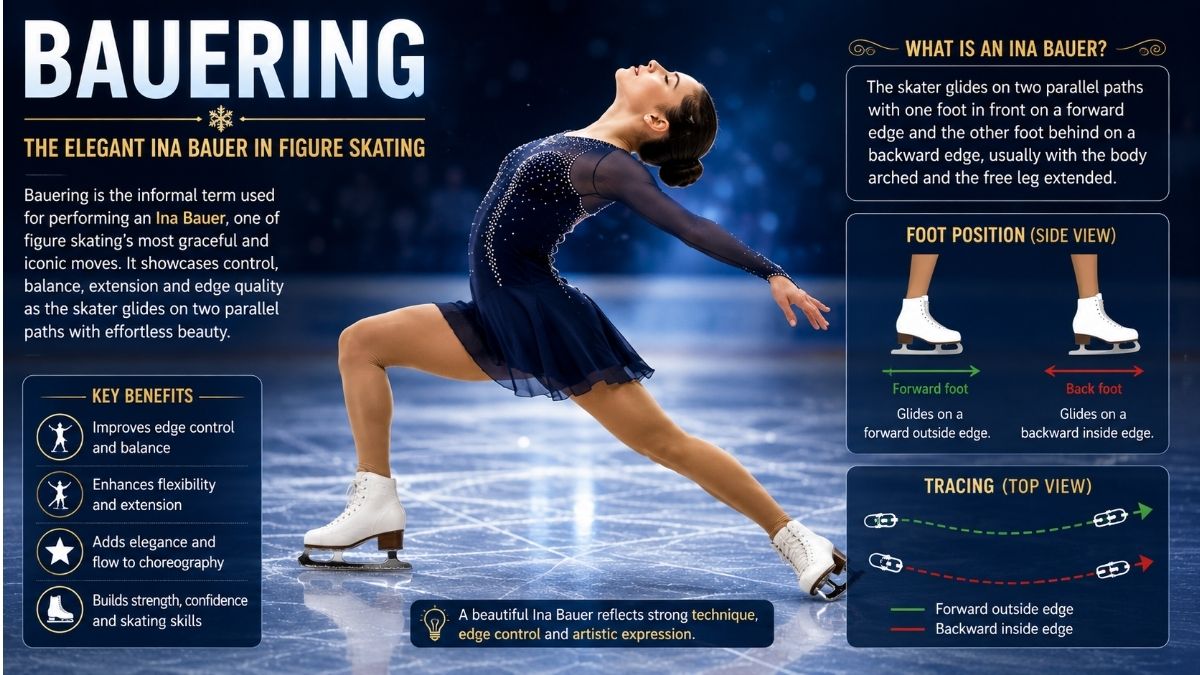
Bauering is an informal expression sometimes used in figure-skating circles to describe performing an Ina Bauer, one of the sport’s most visually distinctive gliding movements. The official name of the element is Ina Bauer rather than “bauering,” but the informal verb is easy to understand. When a skater moves into an Ina Bauer position and travels across the ice, fans or skaters may describe that action as bauering. The movement stands out because the skater uses both feet as they travel along separate, roughly parallel tracings, with one foot on a forward edge and the other on a corresponding backward edge. The result can look remarkably smooth and effortless, although maintaining the required turnout, balance, edge control, and body position demands considerable skating ability. Some performers keep their upper body upright, while others add a dramatic backward arch that creates the sweeping silhouette many viewers immediately associate with elite figure skating.
Bauering is especially interesting because it sits at the intersection of technical skating and artistic presentation. It is not a jump in which the skater leaves the ice, and it is not a conventional spin performed around a fixed point. Instead, the beauty of the movement comes from continuous travel. A skilled skater can use an Ina Bauer to move through a large section of the rink while maintaining clean edges and an extended body line. That combination makes the move useful not only as a recognizable highlight but also as part of choreography that connects more demanding elements.
Where the Ina Bauer Name Comes From
The movement takes its name from Ina Bauer, a German figure skater associated with developing and popularizing the position during the twentieth century. Rather than receiving a generic descriptive label, the move became permanently associated with her name, following a tradition seen elsewhere in figure skating, in which distinctive elements become associated with particular athletes. Today, the Ina Bauer has outlasted the competitive career of the person for whom it was named. Generations of skaters have incorporated versions of the move into exhibition programs, competitive routines and choreographic sequences, demonstrating how one athlete’s innovation can become part of the broader vocabulary of an entire sport.
This historical connection is also why the terminology matters. “Ina Bauer” is the established skating term, while “bauering” functions more like conversational shorthand. Someone writing technically about skating would normally say that a skater “performed an Ina Bauer.” In more casual discussion, however, a fan might say that the skater was “Ina Bauering” or simply “bauering” across the ice. Understanding this distinction helps because searches for the word “bauering” can return unrelated meanings, names, or businesses. In a figure-skating context, however, its most logical interpretation is the act of performing the famous Ina Bauer position.
How Bauering Works on the Ice
The mechanics of bauering are more complex than its graceful appearance suggests. In a basic Ina Bauer, the skater travels with both blades in contact with the ice. The front foot follows a forward tracing while the rear foot travels backward on a separate parallel tracing. The skater’s feet point in substantially different directions, requiring an open hip position and strong control through the legs and ankles. The leading knee is generally bent while the trailing leg remains extended, producing the long visual line that defines the movement. The skater must continue to glide while preventing the blades from drifting into an unstable position.
Good edge control is essential because figure-skating blades are not completely flat underneath. Each blade has an inside and an outside edge, and skaters deliberately control which edge interacts with the ice. Small changes in pressure can change the direction, curve, and stability of the movement. That is one reason a strong Ina Bauer looks so impressive: the audience sees a smooth, flowing position, while the skater continuously manages balance, blade pressure, turnout, speed, and body alignment.
The upper body can significantly change the appearance of bauering. An upright Ina Bauer may emphasize strong posture and clean leg lines, while a backward-leaning variation creates a more dramatic effect. The deepest versions require substantial flexibility in the back and hips, as well as sufficient core strength to maintain control. Contrary to what some viewers may assume, however, a deep backbend is not required for a movement to be an Ina Bauer. The defining feature is the relationship among the feet, blades, and tracings, rather than how far the skater bends backward.
Inside, Outside, and Layback Ina Bauer Variations
There is more than one way to create the familiar bauering position. Skaters can adjust their edges, posture, and extension to create different variations. An inside-edge Ina Bauer typically follows a different curve and balance pattern from an outside-edge version. The distinction may appear subtle to casual spectators. Still, experienced skaters recognize that changing edges affects the entire feeling of the movement, from the direction of lean to the pressure required through the feet.
One of the most dramatic variations is the layback, Ina Bauer. In this form, the skater arches backward while maintaining the underlying foot position and glide. A highly flexible performer may lower the torso considerably, creating an almost bridge-like shape while continuing to travel across the rink. The visual effect can be spectacular because the skater appears suspended in an unusually open position while still moving at speed. Nevertheless, the amount of backward bending is an artistic variation rather than the fundamental definition of the element. An upright version can still demonstrate excellent skating quality when the edges, extension, and posture are controlled.
Why Bauering Looks Easier Than It Really Is
Elite skaters often make difficult movements appear relaxed, and bauering is a perfect example. From the audience’s perspective, it may look like the performer opens the feet and glides. In reality, the position requires a combination of hip turnout, ankle stability, knee control, balance, flexibility, and confidence on the blade. A skater who attempts to force the feet into an extreme position without adequate mobility may lose alignment or place unnecessary strain on the body.
The challenge increases when the Ina Bauer is entered at speed, or immediately before or after another element. Competitive choreography rarely gives skaters unlimited time to prepare. They may need to move smoothly from turns or steps into the position, then exit directly into another transition, spin, or jumping passage. Maintaining musical timing while controlling the edges adds another level of difficulty. The most memorable bauering therefore involves much more than flexibility. It reflects the skater’s ability to combine technical control with presentation.
Bauering as Part of Figure-Skating Choreography
One reason the Ina Bauer remains popular is its extraordinary choreographic versatility. Figure skating is judged not only on whether athletes complete jumps and spins but also on how effectively they transition between major elements and interpret the program. A beautifully placed Ina Bauer can provide a moment of visual expansion after a fast series of turns or before a major musical climax. The elongated posture naturally draws attention across the rink and can make a program feel larger and more expressive.
The movement can also function as a transition rather than a standalone showcase. Skaters may use bauering while preparing for another element or while changing the rhythm of a routine. Because it travels across the ice, it can connect different areas of the rink without appearing as simple forward skating. Choreographers can alter the arms, upper-body position, speed, and duration to match dramatically different musical styles. A classical program may use an elegant extended version, while a contemporary routine could employ a sharper or more unusual upper-body shape while retaining the essential Ina Bauer footwork.
Bauering Versus the Spread Eagle
Bauering is sometimes confused with the spread eagle, another two-foot figure-skating movement that involves significant turnout. The two positions share similarities, particularly because both can create a broad sideways appearance on the ice. However, the leg relationship differs. In a spread eagle, the feet are generally positioned more in line with one another. At the same time, an Ina Bauer places the trailing foot behind the leading foot on a separate parallel tracing. That offset produces the recognizable elongated stance associated with bauering.
For spectators new to figure skating, it’s easier to spot the difference by watching the legs rather than the arms or back. Dramatic upper-body choreography can make two elements appear similar, but the blade placement and tracing reveal what the skater is actually performing. Learning to recognize these details can make watching figure skating more engaging because seemingly decorative movements begin to reveal their technical structure.
Can Beginners Learn Bauer?
A beginner may eventually learn an Ina Bauer. Still, it should normally come after developing reliable basic skating skills before attempting a demanding version; a skater benefits from having comfortable forward and backward skating, reasonable edge control, balance, and familiarity with open-hip positions. Turnout varies considerably from person to person, so copying the exact shape of an unusually flexible elite athlete is neither necessary nor sensible.
Focus on control before depth. A clean, modest Ina Bauer with stable blades is more valuable than an extreme position achieved by forcing the hips or back. Deep layback versions add flexibility requirements and should not be the starting point. Proper instruction is particularly useful because an experienced skating coach can assess whether the feet, knees, hips, and edges are aligned safely in ways that may be difficult for the skater to judge on their own.
Off-ice flexibility can support the movement, but flexibility without strength is not enough. Skaters also need muscular control to hold the position while moving. Core stability helps maintain torso control, leg strength supports the bent leading knee, and ankle control keeps the blades secure. The best development therefore combines skating technique with gradual mobility and strength work rather than relying entirely on stretching.
Common Mistakes When Attempting an Ina Bauer
One common mistake is concentrating so heavily on the backward arch that the underlying skating position deteriorates. Since spectacular photographs often feature extremely flexible athletes, newer skaters may assume that bauering is primarily a backbend. It is not. Blade control comes first. If the feet cannot maintain appropriate tracings, adding a dramatic upper-body position will not create a technically stronger Ina Bauer.
Another problem is forcing turnout beyond the skater’s natural range. The position should come from appropriate hip mobility, not aggressive twisting through the knees or ankles. Skaters may also lose speed when entering the element because they become tense. High-quality barre work usually looks flowing because the athlete maintains momentum rather than fighting the glide. Developing that confidence takes repetition and sound fundamentals.
Why Bauer’s Remains Memorable to Skating Fans
Figure skating includes technically difficult jumps that can determine competition outcomes, yet fans often remember quieter choreographic moments just as vividly. The Ina Bauer has survived for decades because it creates an instantly recognizable shape without interrupting the flow of skating. It highlights qualities that are central to the sport’s identity: edge control, extension, balance, flexibility, speed, and musical expression.
Bauering also shows that impressive figure skating isn’t limited to airborne rotation. A skater can produce a powerful audience reaction while both blades remain on the ice. When a performer holds an Ina Bauer through a dramatic section of music, the effect comes from precision and presentation working together. That is an excellent example of the relationship between athletic technique and artistry.
Conclusion
Bauering is best understood as an informal term for performing an Ina Bauer, the established figure-skating movement in which a skater travels on two separate parallel tracings with one foot moving forward and the other backward. Although it can appear effortless, the movement requires strong edges, balance, hip mobility, leg control and, in more dramatic variations, considerable flexibility.
Its enduring appeal comes from the way it transforms technical skating into visual expression. An Ina Bauer can be upright and restrained or extended into a breathtaking layback position. Yet the movement’s essential character remains the same: controlled travel across the ice through a distinctive two-foot stance. For spectators, understanding bauering deepens appreciation of the skill hidden inside apparently simple choreography. For skaters, mastering it represents more than learning an attractive pose; it means developing the control needed to make difficult skating look beautifully natural.
(FAQs)
What does bauering mean in figure skating?
Bauering is an informal term for performing an Ina Bauer, a figure-skating movement in which the skater glides on two separate parallel tracings, with one foot moving forward and the other backward.
Is bauering an official figure-skating term?
No. Ina Bauer is the recognized technical name of the element. “Bauering” is a casual or informal way of describing the action of performing it.
Is an Ina Bauer difficult to perform?
Yes. A clean Ina Bauer requires strong edge control, balance, hip turnout, leg strength, flexibility, and body alignment. More dramatic layback versions require even greater flexibility and control.
What is the difference between bauering and a spread eagle?
In an Ina Bauer, the skater’s feet travel on separate parallel tracings with one foot positioned behind the other. In a spread eagle, the feet are generally more aligned side by side while pointing in opposite directions.
Can beginner figure skaters learn bauering?
Beginners can eventually learn an Ina Bauer, but they should first develop basic forward and backward skating, balance, edge control, and safe hip mobility. Beginners should learn more advanced layback variations gradually with proper coaching.


Lynne Smith: The Inspiring Truth About Matt Smith’s Mother and Her Supportive Role

Philip Tindall: The Remarkable Life of Mike Tindall’s Father and Former Rugby Captain

Finn Sinclair: Amazing Facts About Olivia Colman’s Son and His Private Life

Maureen E. McPhilmy: The Difficult Divorce from Bill O’Reilly and Her Life Beyond the Headlines

Jessica de Rothschild: The Remarkable Career, Family and Philanthropy of Sacha Gervasi’s Wife

Caroline Friend: The Opera Singer and Audiobook Director Behind Rosamund Pike’s Success

Ted Beckham: The Remarkable Story of David Beckham’s Father

Charlie Comer: Amazing Facts About Jodie Comer’s Brother and His Football Career

Louis Thomas Hardy: Essential Facts About Tom Hardy’s Eldest Son

Elizabeth Anne Hardy: Fascinating Facts About Tom Hardy’s Mother and Her Artistic Life

Mary Joan Hansen: What Is Known About Chris Hansen’s Former Wife

Debbie Paphitis: The Enduring Marriage and Private Life of Theo Paphitis’ Wife

Judith Hurst: Who Is Geoff Hurst’s Wife and What Is Known About Their Life Together?

Sophie Redgrave: Who Is Sir Steve Redgrave’s Daughter and What Is Known About Her?

Nerwey Explained: The Truth Behind the Emerging Online Name and Its Digital Identity

Adele Georgiana Gianopoulos: Facts About Molly Ringwald’s Daughter

Eulala Scheel: Marcia Gay Harden’s Child, Acting Credits and Creative Career

Michael Galeotti: Enation Musician and Bethany Joy Lenz’s Ex-Husband

Jenna Lyn Ward: Acting Career and Marriage to James Denton

Myreadibgmsngs: The Mysterious Search Term Explained, Its Meaning, Origins, and Online Safety
Lynne Smith: The Inspiring Truth About Matt Smith’s Mother and Her Supportive Role
Philip Tindall: The Remarkable Life of Mike Tindall’s Father and Former Rugby Captain
Finn Sinclair: Amazing Facts About Olivia Colman’s Son and His Private Life
Maureen E. McPhilmy: The Difficult Divorce from Bill O’Reilly and Her Life Beyond the Headlines
Jessica de Rothschild: The Remarkable Career, Family and Philanthropy of Sacha Gervasi’s Wife
Caroline Friend: The Opera Singer and Audiobook Director Behind Rosamund Pike’s Success
Ted Beckham: The Remarkable Story of David Beckham’s Father
Charlie Comer: Amazing Facts About Jodie Comer’s Brother and His Football Career
Louis Thomas Hardy: Essential Facts About Tom Hardy’s Eldest Son
Elizabeth Anne Hardy: Fascinating Facts About Tom Hardy’s Mother and Her Artistic Life
-

 Celebrity3 months ago
Tina Raver: Inspiring Facts About Kim Raver’s Supportive Mother
-

 Celebrity2 months ago
Heita Nayyar: Inspiring Family Story Behind Kunal Nayyar’s Mother
-

 Celebrity3 months ago
Tanya Flynn: The Fascinating Story of Sean Maguire’s Wife and Former Police Detective
-

 Celebrity2 months ago
Graham Rooney: The Fascinating Story of Wayne Rooney’s Younger Brother